
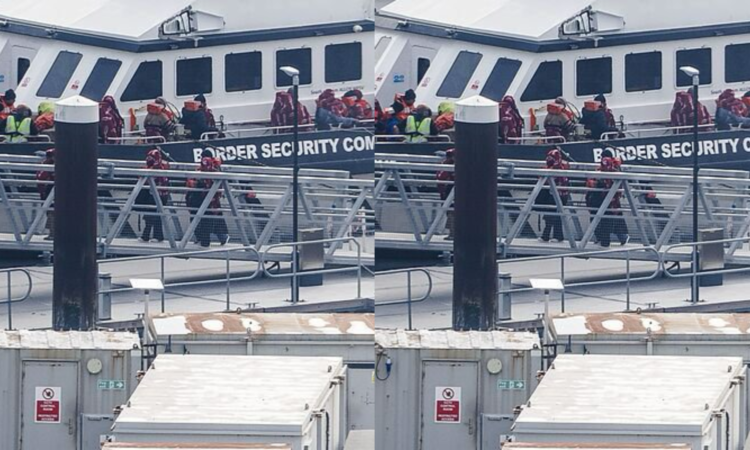
A small boat carrying 32 migrants travelled across the English Channel and came within just two miles of Dover before British border patrol and rescue teams intercepted it.
The inflatable boat reportedly made the journey through thick fog without an escort. It was approaching the Kent coastline when two Border Security Command vessels and an RNLI lifeboat were sent to assist those on board.
The incident has raised fresh questions about border security and how small boats are monitored as they approach British waters. It has also added to the ongoing political debate over illegal immigration, deportations and the government’s handling of Channel crossings.
According to reports, the boat was carrying 32 people when it crossed the English Channel in difficult weather conditions. Thick fog had reduced visibility, making the journey particularly dangerous for passengers and potentially more challenging for rescue teams monitoring the area.
The vessel continued towards Dover without being escorted by British authorities. By the time rescue and border patrol teams responded, it had reportedly reached waters just two miles from the British coastline.
The English Channel is one of the busiest shipping routes in the world, with large commercial vessels travelling through it every day. Small inflatable boats face serious dangers because they are often unsuitable for long journeys across open water, especially during poor weather conditions.
Strong currents, cold water, limited visibility and overcrowding can make these crossings extremely dangerous. Despite these risks, thousands of people continue to attempt the journey from France to Britain each year.
The latest incident comes as the Conservative Party continues to demand tougher action against people entering the UK without permission.
Shadow Home Secretary Chris Philp has called for migrants who arrive illegally to be removed from Britain within seven days. He believes faster deportations would discourage others from attempting dangerous Channel crossings.
Speaking to Conservative Party members, Philp argued that people would be less likely to pay smugglers and risk their lives if they knew they would be returned shortly after arriving in Britain.
Under his proposed approach, people entering the country illegally would be detained and removed either to their country of origin or to a safe third country willing to accept them.
However, introducing such a system would raise legal and practical questions, including how asylum claims would be assessed and whether other countries would agree to accept people removed from Britain.
Philp also criticised the current immigration system, arguing that repeated legal challenges have made it difficult for successive governments to remove people who have no legal right to remain in the country.
He promised that a future Conservative government would introduce much stricter immigration rules and make it easier for authorities to carry out deportations.
One of his main proposals is for Britain to withdraw from the European Convention on Human Rights, commonly known as the ECHR.
The convention is an international agreement designed to protect fundamental human rights and freedoms. Philp believes leaving it would give the UK greater control over immigration decisions and reduce some of the legal barriers involved in removing people from the country.
He argued that Britain should be able to decide who enters and remains in the country without facing lengthy legal challenges.
However, withdrawing from the ECHR would not automatically remove all legal restrictions on deportations. Britain would still have responsibilities under other international agreements, including those protecting refugees and preventing people from being returned to countries where they face torture or persecution.
Philp pointed to Australia’s immigration policies as an example of the tougher approach he believes Britain should consider. He argued that Australia had previously introduced strict measures against unauthorised boat arrivals and that the UK should examine similar policies.
During his speech, the Shadow Home Secretary also raised concerns about proposals to accommodate large numbers of asylum seekers near smaller British communities.
He referred to Piddington, a village in Oxfordshire with a population of approximately 350 people.
According to Philp, Home Office proposals could see as many as 1,256 asylum seekers accommodated near the village. He argued that placing such a large number of people near a small community could put additional pressure on local services and create concerns among residents.
He said communities should not have to deal with the consequences of what he described as Britain’s failure to control its borders.
The Conservative politician also referred to the murder of 27-year-old Rhiannon Whyte, who was attacked in Walsall in 2024.
Rhiannon, a mother of one, was stabbed 23 times during a violent attack that reportedly lasted around 90 seconds.
Her attacker, Deng Majek, a Sudanese asylum seeker, had reportedly arrived in Britain on a small boat approximately three months before the killing.
Reports stated that Majek followed Rhiannon from an asylum hotel towards Bescot Road railway station before attacking her.
Philp used the case to support his argument that immigration enforcement and public safety should be treated as major government priorities.
He said Britain must do more to protect local communities, particularly women and girls.
However, the criminal actions of one individual should not be used to suggest that asylum seekers generally pose the same risk.
The Shadow Home Secretary also criticised Labour’s decision to reopen refugee resettlement routes while small boat crossings continue.
Home Secretary Shabana Mahmood announced plans to restart the UK Resettlement Scheme and introduce three new community sponsorship routes.
The government’s proposals are intended to provide safer and legal ways for vulnerable refugees to enter Britain instead of risking their lives on dangerous journeys.
The arrangements could help people fleeing conflict and persecution, including refugees from Afghanistan and Gaza.
Charities, religious organisations and businesses would also be able to participate in community sponsorship arrangements.
Under these schemes, approved organisations can help refugees find accommodation, access essential services and settle into their new communities.
Thousands of people could eventually arrive through the new routes each year once the programmes become fully operational, although the actual numbers would depend on government decisions and programme capacity.
Philp strongly disagrees with expanding refugee resettlement arrangements while people continue to arrive through unauthorised Channel crossings.
He accused Labour of making it easier for more people to enter Britain when the government should be concentrating on reducing immigration.
He promised that a future Conservative government would close the proposed new schemes until illegal migration had fallen to almost zero.
Philp also expressed concerns about family reunification arrangements, which can allow eligible relatives to join family members already living in Britain.
He argued that opening additional immigration routes before bringing illegal crossings under control would increase pressure on housing, public services and local communities.
His comments come as thousands of migrants continue to make the dangerous journey across the English Channel.
According to figures cited in the original report, more than 20,000 people had crossed the Channel since the beginning of the year.
The report also described a particularly busy two-day period when more than 1,000 migrants reached Britain.
On Sunday, 418 people were reportedly detected travelling in five small boats. The following day, another 609 people were detected in eight vessels.
Together, those figures represent 1,027 arrivals across 13 boats in just two days.
Such increases often happen when weather and sea conditions make it easier for boats to leave the French coastline.
However, even during calmer weather, crossing the English Channel in a small inflatable boat remains extremely dangerous.
Many boats are overcrowded and may have limited safety equipment. Passengers face risks from cold water, strong currents, mechanical failures and large commercial vessels.
The latest incident near Dover has added to questions about how a boat carrying 32 people managed to travel so close to the British coastline before being intercepted.
Philp believes the government needs to focus on stopping unauthorised arrivals and ensuring that people who enter Britain illegally face swift consequences.
He also criticised politicians who support distributing asylum seekers across different parts of the country.
In particular, he challenged Greater Manchester Mayor Andy Burnham’s approach, arguing that spreading asylum accommodation across more towns and villages would not solve the underlying problem.
According to Philp, Britain needs stronger border controls rather than policies that simply move asylum seekers from one location to another.
He argued that the financial and social costs of the current system had become too high and said the interests of British residents should receive greater attention.
The Conservative politician insisted that controlling who enters the country is one of the most important responsibilities of any government.
He also said Britain must have an immigration system that the public can trust.
Meanwhile, the Home Office has defended Labour’s record on tackling Channel crossings.
A spokesperson said the government had already made progress and claimed that crossings had fallen significantly during certain periods.
The department also said Britain had recorded its lowest number of summer arrivals since 2020.
According to the Home Office, joint operations with French authorities had prevented more than 48,000 attempted crossings since the election.
Officials also reported that approximately 1,100 boats and engines had been seized during the same period.
The government said these operations were helping to disrupt criminal gangs involved in organising dangerous Channel journeys.
However, the Home Office acknowledged that more work was needed to tackle the problem.
It said additional officers would be deployed in France to strengthen operations against people-smuggling networks and prevent boats from leaving the French coastline.
The government believes that working closely with French authorities is an important part of reducing dangerous crossings.
French police and border officials are responsible for monitoring their coastline, while British authorities carry out enforcement and rescue operations in UK waters.
Both countries have been working together to identify smuggling networks, intercept equipment and prevent criminal organisations from exploiting vulnerable people.
These networks often charge migrants large amounts of money to arrange journeys in overcrowded boats, despite the serious risks involved.
The government maintains that targeting the criminal groups responsible for organising crossings is essential to reducing the number of people attempting the journey.
Labour also argues that creating controlled legal routes for refugees can provide alternatives for people fleeing war and persecution.
The Conservatives, however, believe tougher deportation measures are necessary to discourage unauthorised arrivals.
The disagreement reflects the wider political debate over how Britain should manage immigration while meeting its international responsibilities towards people seeking asylum.
When migrants are intercepted in the Channel and brought to Britain, they are generally taken to a processing facility where officials carry out identity checks and assess any immediate medical needs.
People who request asylum may have their claims considered under UK immigration law, while others may face enforcement action depending on their individual circumstances.
Arriving without the required immigration permission does not automatically mean someone will be granted asylum. Equally, entering through an unauthorised route does not automatically remove a person’s right to seek refugee protection.
The outcome depends on individual circumstances, applicable laws and any arrangements for returning people to other countries.
Despite the government’s efforts to tackle people-smuggling networks, the latest incident near Dover shows that small boats are still managing to cross one of the world’s busiest shipping routes.
For the Conservatives, the incident strengthens their argument that Britain needs tougher immigration rules and faster deportations.
For Labour, the focus remains on disrupting criminal gangs, improving border enforcement, strengthening cooperation with France and creating controlled legal routes for refugees.
Both approaches face questions about cost, effectiveness, public safety and the country’s international obligations.
With more people continuing to attempt the dangerous Channel crossing, the government faces growing pressure to demonstrate that its policies can deliver lasting results.
The interception of 32 migrants just two miles from Dover is likely to add to that pressure, particularly as questions continue over how the boat travelled so close to the British coastline before rescue and border patrol teams reached it.