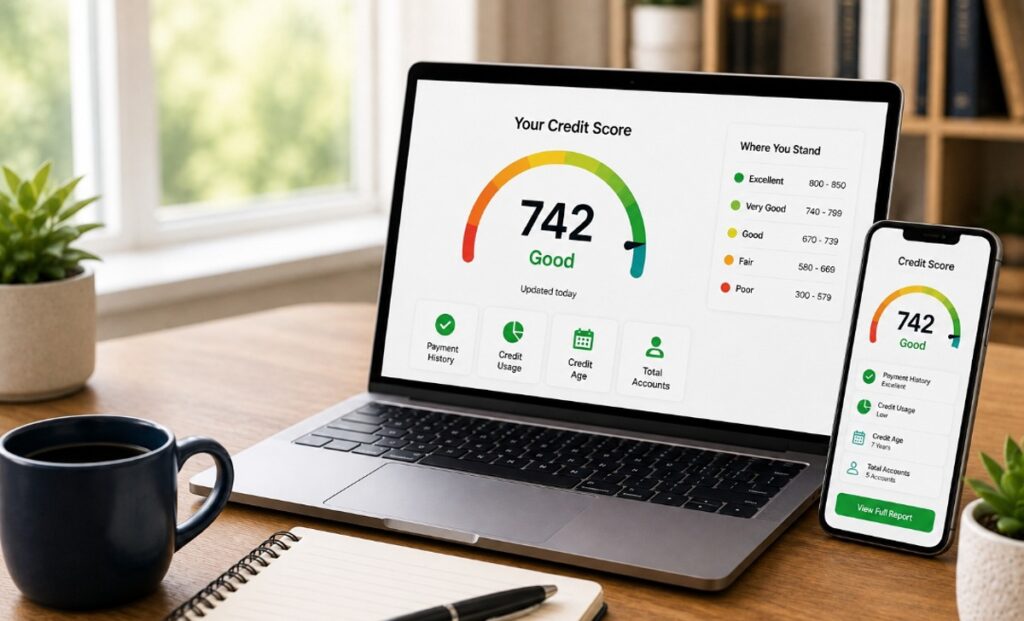
Checking your credit score is one of those things people know they probably should do, but a lot of people never actually get round to it, often because it’s not clear where to start or whether it costs anything. The good news is that checking your score in the UK is completely free, it takes about five minutes, and doing it as often as you like has no negative effect on your score at all.
This guide explains exactly how the UK credit system works, where to check your score for free, what the numbers actually mean, and what to do if you spot something wrong on your file.
Why the UK Has Three Different Credit Scores
Unlike some countries with a single credit bureau, the UK has three separate credit reference agencies: Experian, Equifax, and TransUnion. Each one collects information about you independently, from banks, lenders, and other companies you’ve had financial dealings with, and each one calculates its own score using its own scale.
This means you don’t have one single credit score. You have three, and they can look quite different from each other, not because something is wrong, but because each agency may hold slightly different data and use a different scoring range entirely.
- Experian uses a scale that runs up to 999
- Equifax uses a scale that runs up to 1,000
- TransUnion uses a much smaller scale that only runs up to 710
This is why a score of 750 might be considered excellent on one agency’s scale and would be mathematically impossible on another. Rather than fixating on the raw number, it’s far more useful to look at the band your score falls into, whether that’s described as poor, fair, good, or excellent, since that’s a more consistent way to compare across agencies.
Because lenders don’t all use the same agency either, it’s worth checking your score with all three at some point, particularly before applying for something significant like a mortgage, since a lender might be pulling from an agency where your file looks slightly different than you expect.
Where to Check Each Score for Free
You have a legal right to see the information held about you by all three credit reference agencies, and there are free services that make this straightforward.
For your Experian score and report, the Experian app gives you free ongoing access to your score, your report, and eligible product offers based on your file, updated monthly.
For your Equifax score and report, ClearScore is the most widely used free service in the UK. It shows your Equifax data on its own 0 to 1,000 scale, with an easy to read interface, and updates your score monthly. ClearScore makes its money by recommending credit cards and loans based on your file, but these recommendations are clearly separated from your actual score data, so you can simply ignore them if you’re not interested.
For your TransUnion score and report, Credit Karma provides free access on TransUnion’s 0 to 710 scale. The MoneySavingExpert Credit Club also gives free ongoing access to your TransUnion data, if you’d rather use that instead.
To see all three agencies at once, a service called CheckMyFile offers a short free trial that shows your Experian, Equifax, and TransUnion data together in one place. This can be useful for a one-off deep check, particularly before a major application like a mortgage, but be aware it converts to a paid monthly subscription after the trial period ends, so it’s worth setting a reminder to cancel if you only want the one-time look.
You can also request a basic statutory credit report directly from each agency, which is a more limited version without the extras like a guide score, but it’s free and something you’re entitled to see at any time.
Checking Your Own Score Does Not Harm It
This is one of the most common misconceptions people have, and it stops a lot of people from checking their score regularly out of fear it might make things worse.
When you check your own credit score through any of these services, it’s recorded as what’s called a soft search. Soft searches are only visible to you, not to lenders, and they have no impact on your score whatsoever. This is different from a hard search, which happens when you actually apply for credit, like a loan or a credit card, and which is visible to other lenders and can have a small, temporary effect on your score.
Because of this, there’s no reason to avoid checking regularly. In fact, checking every month or so is a good habit, since it lets you spot changes, catch mistakes, and see the effect of things like paying off a balance or missing a payment.
What Your Score Actually Reflects
Your credit score is essentially a summary of how reliably you’ve managed credit in the past, based on things like:
- Whether you’ve paid credit cards, loans, and bills on time
- How much of your available credit you’re currently using, known as your credit utilisation
- How long you’ve had credit accounts open
- Whether you’re on the electoral roll at your current address, which helps confirm your identity
- Any missed payments, defaults, or County Court Judgments on your file
- How many credit applications you’ve made recently, since a lot of applications in a short space of time can look like financial stress to a lender
No credit score guarantees you’ll be approved for a specific credit card, loan, or mortgage, since individual lenders also apply their own criteria on top of your score. But a higher score generally means better approval odds and often better interest rates, so it’s genuinely worth understanding and improving over time rather than ignoring.
What to Do If You Spot a Mistake
Sometimes your credit file contains something that’s simply wrong: an account that isn’t yours, a payment marked as late when it wasn’t, or an old debt that should have been removed. This happens more often than people expect, and it can drag your score down for no real reason.
If you find an error, you can dispute it directly with whichever credit reference agency holds the incorrect information. All three agencies have a free dispute process built into their websites, and by law they have to investigate your query, usually within 28 days. If the information turns out to be wrong, it gets corrected, and your score can improve noticeably as a result, particularly if the error was something significant like an incorrectly recorded default.
It’s worth checking your file at least once a year specifically for this reason: catching a mistake early, especially before a big application like a mortgage, can save you from a rejection or a worse interest rate that has nothing to do with your actual financial behaviour.
A Few Practical Tips While You’re Checking
- Look at your addresses and make sure your current one is registered on the electoral roll, since this is one of the simpler things that can affect your score if it’s missing
- Check for any accounts you don’t recognise, which could be a sign of identity fraud rather than just an administrative mix-up
- Look at your financial links, meaning any joint accounts or previous addresses shared with another person, since their credit history can sometimes affect how lenders view yours
- If you’re planning a big application soon, like a mortgage, check all three agencies rather than just one, since lenders don’t all pull from the same source
Simple Ways to Improve Your Score Once You Know It
Once you’ve checked your score and had a look at what’s on your file, a few consistent habits tend to make the biggest difference over time.
Pay everything on time, every time. Payment history is one of the heaviest factors in your score, so even one missed payment on a credit card, phone contract, or loan can knock your score down and stay on your file for years. Setting up direct debits for at least the minimum payment on anything with a fixed date removes the risk of simply forgetting.
Keep your credit utilisation low. This means how much of your available credit you’re actually using at any given time. As a rough guide, staying under about 30 percent of your total available credit limit tends to look healthier to lenders than regularly maxing out a card, even if you pay it off in full each month.
Get on the electoral roll. This is one of the quickest wins available, since it’s simply a registration step rather than something that takes months to build up, and it directly helps confirm your identity to lenders.
Avoid making several credit applications in a short space of time. Each hard search stays visible for around 12 months and a cluster of them close together can make you look like you’re in financial difficulty, even if that’s not the case. Spacing out applications, and only applying when you actually need to, helps protect your score.
Keep older accounts open where it makes sense. The length of your credit history matters, so closing your oldest credit card, even one you rarely use, can sometimes shorten your overall history and have a small negative effect. If there’s no annual fee and no real downside, it’s often better left open and used occasionally.
Build credit gradually if you’re starting from very little. If you have thin or no credit history, a low-limit credit card used for small purchases and paid off in full every month is one of the more reliable ways to start building a track record, since it shows lenders a pattern of responsible use over time.
Frequently Asked Questions
Does checking my own score affect my chances of getting a mortgage? No. Checking your own score is always a soft search, regardless of how many times you do it, and lenders never see soft searches when they assess your application.
Why is my score different between ClearScore and the Experian app? This is completely normal and expected, since they’re pulling from different credit reference agencies with different data and different scales. Comparing the band, such as good or excellent, rather than the exact number, gives a more accurate picture.
How often should I check my credit file? Checking once a month is a reasonable habit for most people, since it’s free and lets you catch problems early. It’s especially worth checking a few months before any major application, like a mortgage or a large loan, to give yourself time to fix anything that looks wrong.
Will paying off a credit card completely help my score straight away? It usually helps, though the change may not show up instantly, since credit reference agencies update on a rolling basis rather than the second a payment clears. Give it a few weeks to reflect properly on your file.
Can a partner’s poor credit history affect my own score? Only if you have a financial link with them, typically through a joint account, joint mortgage, or joint loan. If you’ve had a joint financial product with someone in the past, their credit behaviour can influence how lenders view your file, even after the joint product ends, unless you formally request the link be removed once it’s no longer relevant.