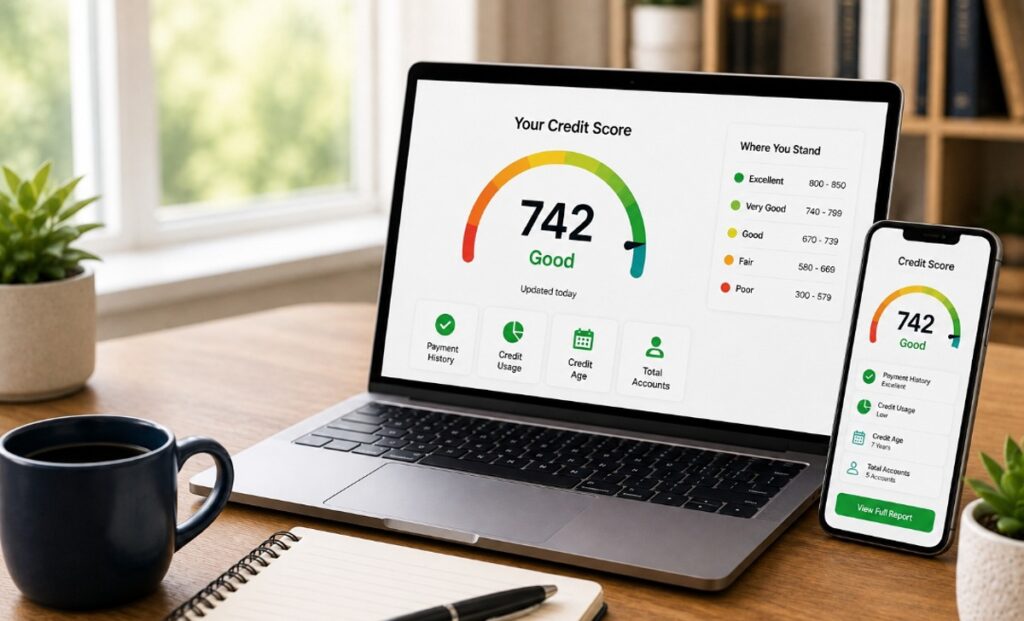
If you’ve checked your credit score and are left wondering whether the number you’re looking at is actually any good, you’re not alone. Unlike some countries that use a single, universal credit score, the UK has three separate credit reference agencies, each running its own scale, its own scoring model, and its own definition of what counts as good.
This means the same person can look at three different numbers from three different sources and have no idea which one to trust, even though none of them is actually wrong.
This guide explains how each agency’s scale works, what generally counts as a good score with each one, and what actually matters more than the number itself when you apply for credit.
Why There Isn’t One Single “Good” Score
In the UK, the three main credit reference agencies are Experian, Equifax, and TransUnion. Each one collects data independently, sometimes from slightly different lenders, and each one calculates a score using its own model and its own scale.
Because the scales themselves are completely different, a “good” score looks like a completely different number depending on which agency you’re checking:
- Experian typically uses a scale running up to 999, and a good score generally falls somewhere in the region of 881 and above
- Equifax commonly uses a scale running up to 1,000 (some services report a shorter 0 to 700 scale depending on the model in use), and a good score is typically considered to start somewhere in the low-to-mid hundreds, well below where Experian’s “good” band begins numerically
- TransUnion uses a notably smaller scale, running only up to 710, and a good score here generally starts somewhere around the low 600s
This is genuinely confusing at first glance, since a TransUnion score of 600 and an Experian score of 600 represent very different levels of creditworthiness, even though the numbers look identical. The safest way to interpret your score is to check the specific band your number falls into, poor, fair, good, or excellent, as labelled by the agency itself, rather than comparing raw numbers across different services.
Rough Guide to Each Agency’s Bands
While exact cut-off points can shift slightly between different tools and reporting periods, the broad shape tends to look like this across all three agencies:
Experian (typically 0 to 999)
- Very poor to poor: roughly the bottom third of the scale, where most credit applications are likely to be declined or only available through specialist lenders
- Fair: broadly the middle band, where mainstream credit becomes more available, though often at less competitive rates
- Good: broadly the next band up, where most standard lenders will consider you a reasonably safe bet
- Excellent: the top band, generally unlocking the most competitive rates and widest choice of products
Equifax (commonly 0 to 1,000, though some tools use a 0 to 700 model)
- The “good” band on Equifax’s scale tends to start much earlier, numerically, than Experian’s, which can be genuinely confusing if you’re comparing the two directly. A score that looks unremarkable on Equifax’s scale can represent the same underlying creditworthiness as a much higher-looking Experian number.
TransUnion (0 to 710)
- Because this scale is smaller overall, a score like 600 can represent a genuinely strong position, roughly equivalent to being well into the “good” or even “excellent” band, rather than looking modest the way it might on a scale that goes up to 999 or 1,000.
Given how much these exact boundaries can shift between different tools and reporting periods, the most reliable approach is to check the specific band label shown by whichever service you’re using, Experian’s app, ClearScore for Equifax, or Credit Karma for TransUnion, rather than trying to memorise precise numerical cut-offs.
Where the Average UK Adult Sits
It’s worth knowing that a meaningful share of UK adults sit somewhere in the “fair” to “good” range across these agencies, rather than at the very top or bottom of any scale. This means reaching “good,” while genuinely useful, doesn’t require reaching some rare, exceptional level, it simply means being a bit above where a large portion of the population currently sits.
Lenders do reserve their very best offers, the lowest interest rates and the most attractive credit card rewards, for people in the “excellent” band specifically, so there’s still a real benefit to pushing beyond “good” if you’re aiming for the most competitive products, even though “good” itself already opens up most mainstream lending.
What a Good Score Actually Unlocks
Understanding the label matters less than understanding what it actually means for your everyday financial life. Broadly speaking:
- Poor or very poor scores tend to mean most standard credit applications are declined, and any credit you can access is likely to come from specialist lenders charging noticeably higher interest rates to offset the perceived risk
- Fair scores typically mean mainstream credit becomes accessible, but usually not at the most competitive rates, and product choice can still be fairly limited compared to someone with a stronger file
- Good scores generally mean most mainstream lenders, including high-street banks, will consider you a reasonably safe bet, opening up standard credit cards, competitive loan rates, and mainstream mortgage products
- Excellent scores tend to unlock the very best available rates and the widest possible choice of products, including premium credit cards and the most competitive mortgage deals
Your Score Is Only One Part of the Picture
It’s worth being clear that your credit score, however good, is never the only thing a lender looks at. Mortgage lenders in particular also weigh up things like your income and affordability, the size of your deposit, how stable your employment has been, and your overall spending patterns, not just the number on your credit file. This means a genuinely strong score improves your chances significantly, but it doesn’t guarantee approval on its own, and conversely, a slightly lower score doesn’t automatically rule you out if the rest of your financial picture is solid.
It’s also worth remembering that each individual lender applies its own internal criteria on top of whatever score a credit reference agency gives you. Two lenders looking at the exact same credit file can reach different conclusions about whether to approve you, and on what terms, since the credit reference agency’s score is only one input into their own decision-making process.
How to Actually Improve Your Score
Regardless of which agency’s scale you’re looking at, the same core habits tend to move your score in the right direction across all three.
Get on the electoral roll. This is one of the simplest, highest-impact actions available, since it directly confirms your identity and address to lenders, and it typically produces a noticeable improvement fairly quickly.
Pay everything on time, consistently. Payment history carries significant weight across every scoring model, so even a single missed payment can have a real, lasting effect, while a long run of on-time payments steadily builds your score over time.
Keep your credit utilisation low. This refers to how much of your available credit you’re actually using at any given time. Staying well under your limit, rather than regularly running close to it, tends to look considerably healthier to lenders, even if you always pay the balance off in full.
Check your file for mistakes. Errors on your credit report, an account that isn’t yours, an incorrectly recorded late payment, are more common than people expect, and correcting them can produce a genuine improvement, sometimes a significant one, once fixed.
Build a thin file gradually if you’re starting from very little. If you have little to no credit history, a low-limit credit builder card, used for a small, regular purchase and paid off in full every month, is one of the more reliable ways to start demonstrating responsible credit use.
Avoid applying for multiple credit products in a short space of time. Each application typically triggers a hard search on your file, and several of these close together can make you look financially stressed to a lender, even if that isn’t the case, which can work against you across all three agencies simultaneously.
Why Comparing Scores With Friends or Family Can Be Misleading
It’s tempting to compare your score with a partner, friend, or family member to gauge how you’re doing, but this only works if you’re both looking at the same agency’s scale, using the same app, and checked around the same time. Someone quoting you their “750” from one service means something completely different from your own “750” if you’re pulling that number from a different provider. If you do want to compare, the safest way is to check the same agency, ideally on the same day, since scores can also shift slightly week to week as new data comes in.
Does a Good Score Mean You’ll Definitely Be Approved?
Not necessarily, and this trips a lot of people up. Credit reference agencies calculate a score based on your file, but individual lenders apply their own separate internal criteria on top of that score when deciding whether to actually approve you. This means it’s entirely possible to have a strong, “good” or “excellent” score with one agency and still be declined by a specific lender, if that lender’s own criteria happen to weigh something differently, such as your income relative to the amount you’re applying to borrow, or a specific type of account they’re cautious about.
This is also why applying to several lenders in a short space of time after a single rejection isn’t a good strategy. Each application can register as a hard search, and a cluster of them close together can actually make your file look riskier, compounding the original problem rather than solving it. If you’re declined, it’s usually worth understanding why first, sometimes by requesting details from the lender or reviewing your file for anything that might explain it, rather than immediately reapplying elsewhere.
What “No Score” Means, and Why It’s Different From “Bad”
Some people check their file and find they don’t have a meaningful score at all, rather than a low one. This is common for people who are young, have recently moved to the UK, or have simply never used any form of credit. A missing or “thin” file isn’t the same as a poor score, but it can be treated cautiously by lenders in a similar way, simply because there isn’t enough data for them to judge your reliability either way. Building a file from this starting point follows the same basic steps as improving a low score: getting on the electoral roll, and using a credit builder product responsibly to start generating a visible track record.
Frequently Asked Questions
Is a “fair” score bad? Not necessarily. “Fair” typically sits in the middle of the range and often still allows access to mainstream credit, just usually not at the most competitive interest rates. It’s a reasonable position to be in, and moving from “fair” to “good” tends to open up noticeably better terms without requiring years of effort.
Does my income affect my credit score? Not directly. Your credit score is based on your credit history and behaviour, not your income. However, lenders do consider your income separately, alongside your score, when deciding how much they’re willing to lend you and whether you can afford the repayments.
Can my score go down even if I haven’t done anything wrong? Yes, in some cases. If a joint account holder or someone you have a financial link with has a poor payment history, this can sometimes affect your own file. Scores can also dip slightly after a hard search, even a legitimate one, or if an old positive account closes and slightly shortens your average credit history.
How often does my score actually update? This varies by agency and by which lenders report to them, but many services update monthly. Some individual accounts, such as certain credit cards, may report more frequently, so your score can shift gradually throughout the month rather than only on a single fixed date.
Should I be worried if my three scores from Experian, Equifax, and TransUnion look quite different? Not necessarily, given how differently each scale is structured. What matters more is checking that each one falls into a similar band, poor, fair, good, or excellent, relative to its own scale, rather than expecting the raw numbers themselves to align.