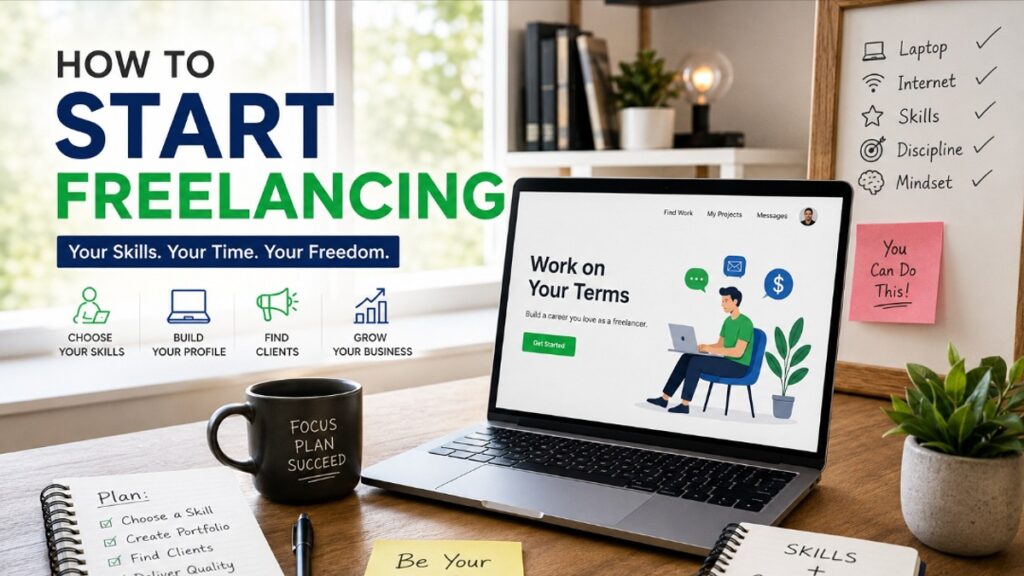
Freelancing has become one of the most common ways for people in the UK to earn extra money or build a full career on their own terms. Whether you want to write, design, code, teach, edit video, or offer some other skill, the barrier to getting started is lower than most people expect.
What trips people up is not the freelancing itself, but the admin around it. Registering properly, understanding tax, picking the right platforms, and setting rates that actually make the work worthwhile.
This guide walks through the whole process in order, from figuring out what to offer through to getting paid and staying on the right side of HMRC.
Step 1: Find Out What You Can Offer
Before touching any platform or paperwork, get clear on what service you are selling. This sounds obvious, but a lot of people struggle to get their first client simply because their offer is too vague.
A few ways to narrow this down:
- Think about what you already do well, whether that came from a job, a hobby, or something you taught yourself
- Look at what you enjoy enough to keep doing consistently, since freelancing rewards people who stick with it
- Check what’s actually in demand rather than picking something purely because you like it, by browsing freelance job boards to see what clients are hiring for right now
You do not need to find the perfect niche on day one. Many successful freelancers start with a slightly broad offer and narrow it down over time as they learn which projects they enjoy and which clients pay well. Starting with some focus beats starting with none at all.
Step 2: Build a Simple Portfolio
Clients want to see evidence you can do the work before they hire you, especially the first time. This does not need to be elaborate.
- A basic personal website with a few examples of your work
- A free portfolio page on a site like Behance or Clippings.me, depending on your field
- Even a well organised LinkedIn profile with sample work attached can be enough to start
If you are completely new to your chosen skill and have no paid work to show yet, consider doing one or two small projects for free or at a reduced rate, purely to build something real to show future clients. Just be clear with yourself that this is a short-term bridge, not a long-term pricing strategy.
Step 3: Register as Self-Employed With HMRC
This is the step people put off the longest, but it is straightforward and only takes about ten minutes online.
In the UK, if you earn more than £1,000 from self-employment in a tax year, known as the trading allowance, you are required to register as self-employed with HMRC. The tax year runs from 6 April to 5 April, and you need to register by 5 October following the end of the tax year in which you started earning this income.
To register, you will need:
- Your National Insurance number
- Basic details about the type of work you’ll be doing
- An email address to set up your Government Gateway account, which is how you’ll manage your tax affairs online going forward
Once registered, HMRC will send confirmation, usually including your Unique Taxpayer Reference, or UTR, which you’ll need whenever you deal with your tax return.
It is worth registering as soon as you start earning seriously, rather than waiting until you’re close to the deadline, since it gives you more time to get familiar with the system before you actually need to file anything.
Step 4: Understand How Freelance Tax Actually Works
This is the part that causes the most anxiety for new freelancers, mostly because nobody explains it clearly the first time.
You are taxed on profit, not income. That means you can deduct legitimate business expenses, such as software subscriptions, a portion of your home internet and utility bills if you work from home, equipment, and platform fees, before working out what you owe tax on.
The £1,000 trading allowance is a choice, not just a threshold. If your income is above £1,000, you can either deduct your actual expenses, or simply deduct the flat £1,000 allowance instead, whichever works out better for you. If your genuine expenses are low, the flat allowance is often simpler and sometimes more generous.
You’ll file a Self Assessment tax return every year. The deadline for online filing and payment is 31 January, covering the tax year that ended the previous April. Missing this deadline triggers an automatic penalty, even if you don’t actually owe any tax, so it is worth putting the date in your calendar well in advance.
You’ll likely pay both Income Tax and Class 4 National Insurance on your profits above certain thresholds, in addition to any Class 2 National Insurance depending on your circumstances. The exact amounts depend on how much you earn, so using HMRC’s own calculators or speaking to an accountant once your income grows is worth doing rather than guessing.
Making Tax Digital is being phased in. From April 2026, freelancers and sole traders with income above £50,000 are required to keep digital records and submit quarterly updates to HMRC using compatible software, rather than filing one annual return. If your income is below that threshold, this doesn’t affect you yet, but it’s worth being aware of if you expect to grow past it.
A simple habit that saves a lot of stress: set aside a percentage of every payment you receive, often somewhere around 25 to 30 percent depending on your total income, into a separate savings account the moment it lands, so the money for your tax bill is already there when January comes around.
Step 5: Decide Whether You Need Insurance
As a freelancer, you are responsible for arranging your own protection, since there’s no employer safety net behind you.
- Professional indemnity insurance covers you if a client claims your work caused them financial loss, which matters more in fields like consulting, design, or anything where mistakes could be costly for the client
- Public liability insurance matters more if you ever meet clients in person or work in their space
- Income protection insurance can provide a safety net if illness or injury stops you from working for an extended period, something employed people often get through work benefits without thinking about it
Not every freelancer needs all of these from day one, but it’s worth understanding what each one covers so you can make an informed decision as your income grows, rather than only thinking about it after something goes wrong.
Step 6: Choose Where to Find Clients
There are two broad routes into freelance work: platforms, and direct outreach. Most freelancers end up using a mix of both.
Freelance platforms are the easiest starting point because they bring clients to you rather than requiring you to go find them.
- Upwork covers a huge range of industries and skill levels, from entry-level tasks to highly specialised, well paid contracts. It works on a proposal system, where you bid or pitch for individual jobs.
- Fiverr works differently, letting you list fixed-price “gigs” that clients browse and buy directly, which suits productised services with clear, well defined deliverables.
- PeoplePerHour is UK-focused and can be a good fit if you want to work mainly with British clients.
- Freelancer.com offers both project-based and contest-based work across many categories.
- Toptal is far more selective, aimed at experienced freelancers in software, design, and finance, with a screening process to get in.
Most platforms take a commission from your earnings, so factor that into how you price your work. Building a strong profile with genuine, positive reviews matters enormously here, since it’s often the single biggest factor in whether a new client picks you over someone else.
Direct outreach takes more effort upfront but tends to pay off better over time, since you’re not competing against dozens of other freelancers for the same job post.
- Reach out to former employers or colleagues, who may need freelance help without realising you’re now available for it
- Post on LinkedIn that you’re available for work, being specific about what you offer
- Identify businesses that could genuinely benefit from your service, find the right contact, and send a short, personalised message focused on how you can help them, not on your own credentials
- Ask happy clients if they know anyone else who might need similar work, since referrals are consistently one of the strongest sources of new business for freelancers
Even a small response rate on direct outreach can keep steady work coming in once you build up the habit of sending it regularly.
Step 7: Set Your Rates Properly
Undercharging is one of the most common mistakes new freelancers make, usually out of a fear that nobody will hire them otherwise.
- Research what others in your field and experience level are charging, using platform listings and freelancer communities as a guide
- Start at a competitive but fair rate rather than the absolute lowest you can find, since extremely low prices can actually make clients suspicious of quality
- Remember that your rate needs to cover more than just your working hours. It also needs to account for time spent on admin, finding clients, tax, and any periods without work
- Review and raise your rates periodically as your portfolio and reviews grow, rather than staying at your starting price indefinitely
Step 8: Get Comfortable With the Feast or Famine Cycle
Almost every freelancer experiences stretches where work floods in, followed by quieter periods where things go unexpectedly slow. This is normal, not a sign you’re doing something wrong, though it does take some adjustment if you’re used to a predictable monthly salary.
A few things that help manage this:
- Build a financial buffer during busier periods rather than spending everything as it comes in
- Keep some client outreach going even when you’re fully booked, so you’re not starting from zero the moment a quiet period hits
- Diversify where your work comes from, rather than relying entirely on one platform or one client, so a single lost contract doesn’t leave you with nothing
Common Questions New Freelancers Ask
Do I need to set up a limited company to freelance? No, most people start as a sole trader, which is simpler and involves less admin. A limited company can become more tax efficient once your income grows past a certain point, but it also brings extra responsibilities like filing company accounts, so it’s usually worth waiting until an accountant can look at your specific numbers before switching.
Can I freelance alongside a full-time job? Yes, and many people do exactly this while testing whether freelancing could replace their main income eventually. You still need to register as self-employed once your side income passes £1,000 in a tax year, and you’ll declare both your employed and self-employed income on the same Self Assessment return.
What happens if a client doesn’t pay me? This is one of the real risks of freelancing outside a platform. Using contracts, even simple ones, and asking for partial payment upfront on larger projects, reduces the risk. On platforms like Upwork and Fiverr, payments are usually held and released through the platform itself, which offers more protection than working entirely off-platform with a new client.
Do I need a business bank account? It’s not a legal requirement for a sole trader, but keeping a separate account purely for freelance income and expenses makes tracking your tax position far easier than trying to untangle it from your personal spending at the end of the year.