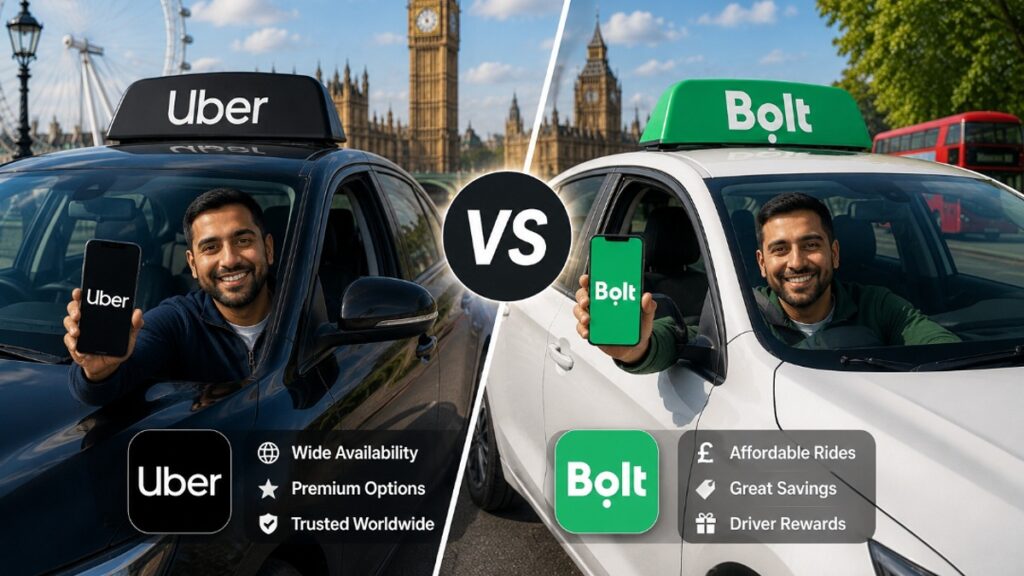
If you’re deciding between driving for Uber or Bolt, or wondering whether you should just run both apps at once, this comes up constantly in driver forums and Facebook groups, and the honest answer is more nuanced than a simple “one is better than the other.”
Commission rates, fare structures, and driver demand all differ between the two platforms, and which one actually puts more money in your pocket depends heavily on where you’re driving, when, and what kind of trips are common in your area.
This guide breaks down exactly how the two platforms compare for UK drivers, so you can make an informed decision rather than just going with whichever app you downloaded first.
Commission
This is where the two platforms genuinely differ, and it’s worth understanding clearly before anything else.
Uber takes a flat commission of around 25 percent from each fare. If a ride earns £20, roughly £5 goes to Uber, leaving you with about £15.
Bolt generally charges a lower commission, typically somewhere between 15 and 20 percent depending on your specific location and, in some cases, your driver performance level. On that same £20 fare, Bolt’s lower commission means you’d typically keep somewhere between £16 and £17.
On commission alone, Bolt has a genuine structural advantage for UK drivers, since a lower cut means you keep more of each fare, all else being equal. This is consistently the single biggest reason drivers cite for preferring Bolt when comparing the two platforms directly.
Fare Structure
Commission percentage alone doesn’t tell the whole story, since the two platforms also price rides differently, and this affects how the commission difference actually plays out in practice.
Bolt tends to use a higher base fare combined with somewhat lower per-mile and per-minute rates. This structure tends to favour shorter trips, since a bigger portion of the fare comes from the flat base charge rather than accumulating gradually over distance and time.
Uber tends to use a lower base fare with higher per-mile and per-minute rates, which favours longer journeys, since the per-distance and per-time charges have more room to add up over a longer trip.
The practical effect of this is that Bolt often has a slight edge on short, frequent trips, common in dense urban areas with lots of quick point-to-point journeys, while Uber can be more competitive on longer trips, airport runs, or journeys that cover more distance and time.
VAT Changes
Since the start of 2026, a change to how VAT applies to private hire fares in the UK means VAT is now charged on the full fare rather than just on the platform’s commission portion, as was previously the case. This has pushed total fares up across the board, on both Uber and Bolt, by somewhere in the region of 12 to 15 percent compared with late 2025 pricing.
This change applies equally to both platforms, so it doesn’t shift the competitive balance between Uber and Bolt specifically. It does mean that if you’re comparing current earnings against older figures you might have seen quoted from before 2026, the underlying numbers have moved, so it’s worth working from current, up to date figures rather than anything you might remember from a year or two ago.
Driver Demand and Volume
Commission and fare structure are only half the picture. The other critical factor is simply how much work is actually available on each platform in your specific area.
Uber generally has a larger overall network of active drivers and riders in the UK, having been established in the market for longer. This often translates into a larger volume of ride requests, particularly in major cities, though it also means more competition from other drivers for those same requests.
Bolt has grown rapidly and is a genuinely serious competitor, particularly strong in certain UK cities and among price-sensitive riders, since Bolt has historically used lower fares as a way to win market share from Uber. Depending on your specific city, Bolt’s rider demand can be lower than Uber’s, which matters just as much as the commission difference, since a lower commission on fewer rides can easily net out to less total income than a higher commission on a larger volume of rides.
This is exactly why there’s no single, universal answer to which platform pays more. The honest answer depends heavily on your specific city, the time of day you typically drive, and the kind of trips that are common in your area.
Why Most Experienced Drivers Run Both
Given how much the “better” platform varies by location, time, and trip type, a large proportion of experienced UK private hire drivers run both apps simultaneously, a practice often called multi-apping, rather than committing exclusively to one.
The logic is straightforward: rather than guessing in advance which platform will send more or better-paying requests on a given day, running both lets you simply accept whichever ride comes in first, or compare offers if both apps ping around the same time, and adjust which app you lean on more heavily based on what you’re actually seeing in real time.
A few practical things to know if you’re considering this approach:
- Your private hire insurance needs to explicitly cover private hire work in general, rather than being restricted to a single named platform, since some policies are written more narrowly
- Managing two apps at once takes a bit more attention than running just one, particularly around accepting or declining requests quickly
- Many drivers find that Uber tends to be stronger for airport runs and higher-value business-style demand, while Bolt tends to fill in gaps between Uber requests, though this pattern isn’t universal and varies by city
How to Actually Work Out Which Is Better for You
Rather than relying purely on general commission figures, the most reliable way to know which platform genuinely pays better for you specifically is to track your own results directly.
- Log your completed trips, total fare income, and fuel costs separately for each platform over at least a couple of weeks, since a single day can be skewed by one-off events like airport surges or unusual local demand
- Pay attention to idle time waiting for ride requests on each app, not just the commission on the rides you do complete, since a platform with a lower commission but long gaps between rides can easily underperform a platform with a higher commission but a steady stream of requests
- Factor in “dead miles,” meaning the distance you drive to reach a pickup with no fare attached, since this varies by platform and area and directly eats into your actual per-hour profit regardless of the commission rate
- Compare your net income after fuel, not just gross fares, since fuel and vehicle wear apply the same regardless of which platform sent you the ride
Tracking this yourself for a couple of weeks on each platform, or running both simultaneously and reviewing which one is contributing more to your actual take-home pay, gives you a far more reliable answer than any general commission comparison can, since your specific city, schedule, and driving pattern all genuinely affect the result.
Requirements
It’s worth knowing that the underlying requirements to drive for either platform in the UK are broadly similar, since both rely on the same private hire licensing system.
You’ll need a private hire licence from your local council or TfL, private hire insurance, a vehicle meeting each platform’s specific standards, and to pass a background check.
If you already hold a private hire licence and insurance from driving for one platform, adding the other typically doesn’t require starting the licensing process over, just completing that specific platform’s own driver sign-up process.
Does Surge Pricing Favour One Platform Over the Other?
Both platforms use surge or dynamic pricing during periods of high demand, temporarily increasing fares when there are more riders requesting trips than available drivers nearby. Neither platform has a consistent, universal advantage here, since surge intensity depends entirely on local, real-time conditions rather than a fixed difference between the two apps.
During major events, bad weather, or late-night periods after venues close, both Uber and Bolt commonly show significant surge multipliers, and which platform surges harder on any given night varies by location and can flip from one week to the next.
What’s worth knowing is that surge periods are exactly when running both apps simultaneously pays off most clearly, since you can simply see which platform is showing a stronger surge multiplier in real time and prioritise accepting requests from whichever one is currently paying more, rather than being locked into whichever single app you happened to commit to for the night.
Airport Pickups
Airport work deserves its own mention, since it often behaves differently from regular city driving on both platforms. Airport pickups typically involve additional fees, such as the Heathrow terminal drop-off charge that now appears as a separate line item on both platforms’ receipts, and airport queuing systems can mean a longer wait for your next fare compared with cruising for shorter urban trips.
Some drivers specifically favour Uber for airport work, citing generally stronger demand from business travellers and tourists at major UK airports, though this varies by specific airport and isn’t a universal rule across every city.
What Riders’ Preferences Tell You Indirectly
It’s worth understanding a little about how riders choose between the two platforms, since rider behaviour directly shapes how much work is available to you as a driver. Bolt has built much of its UK growth around being the more price-competitive option, which tends to attract more price-sensitive riders, particularly for shorter, everyday trips.
Uber’s longer establishment in the UK market and broader brand recognition means it often retains a larger share of business travellers, tourists less familiar with local alternatives, and riders who simply defaulted to Uber before Bolt became a serious option.
Neither pattern is universal, but it helps explain why the “better” platform for a driver can genuinely differ between a city centre with heavy tourist and business traffic versus a suburban area dominated by local, cost-conscious riders.
Frequently Asked Questions
Can I be deactivated from one platform for driving for the other? No, driving for both Uber and Bolt simultaneously is normal, common practice among UK private hire drivers and isn’t against either platform’s terms. Multi-apping is widely accepted across the industry.
Do I need separate insurance for each platform? No, provided your private hire insurance policy covers private hire work in general rather than being restricted to a specific named platform. It’s worth double-checking this explicitly with your insurer before you start multi-apping, since some cheaper policies are written more narrowly.
Does switching between the two platforms confuse riders or affect my ratings? No, your rating and trip history on each platform are entirely separate and don’t interact with each other, so building a strong rating on one platform has no bearing on the other.
Is one platform easier to get approved for as a new driver? Both platforms rely on the same underlying private hire licensing requirements, so the core approval process is broadly similar. Some drivers report Bolt’s own onboarding process, once your private hire licence is already in place, moving slightly faster than Uber’s, though this can vary by region and change over time as both platforms adjust their processes.
Should a brand new driver start with just one platform first? It’s a reasonable approach, since managing two apps at once while still learning the basics of private hire driving can be a lot to juggle early on. Many new drivers start with a single platform for the first few weeks to build confidence and a rating, then add the second platform once they’re comfortable with the day to day routine.