
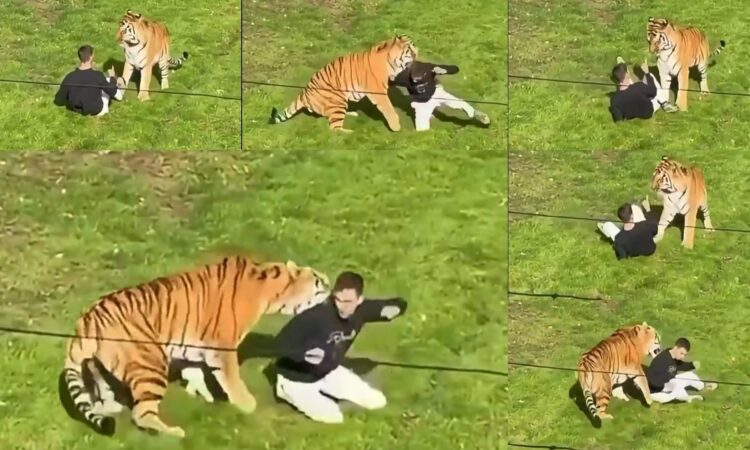
A visitor who reportedly saw a man shortly before he was killed by a tiger at Yorkshire Wildlife Park has shared details about their brief encounter, urging people to stop making hurtful comments and remember the family grieving his death.
The man died on Saturday, October 10, 2026, after entering a tiger enclosure at the popular wildlife attraction near Doncaster in South Yorkshire.
Since the incident, several disturbing videos have circulated on social media, with many people questioning why he entered the enclosure and how he managed to get so close to a dangerous wild animal.
However, one visitor, identified as Richard White, has spoken about what he noticed before the tragedy and encouraged people to show more compassion.
Richard, who reportedly uses the social media account @RichardWhite21, claimed that he and his group were leaving the wildlife park when the man walked past them.
According to Richard, the man appeared to be alone, and he did not notice anyone accompanying him at the time.
He also suggested that the man might have had autism and hearing difficulties, although these were his personal impressions and have not been confirmed by police or medical professionals.
Sharing his experience on social media, Richard wrote:
“He walked past us as we were leaving, not a carer or family member in sight. Could tell he was autistic and deaf straight away. It’s quick to judge, just remember he’s got a family. RIP.”
His comments attracted attention online, particularly because many people had already begun expressing strong opinions about the man’s actions before the fatal attack.
While some social media users criticised the man for entering a restricted area, others agreed with Richard that the focus should be on the loss of life and the family affected by the tragedy.
However, Richard’s observations do not establish that the man had autism, hearing difficulties or any other disability.
Autism and hearing loss cannot be reliably identified simply by watching someone walk past, and there is no confirmed evidence that the man needed a carer or assistance while visiting the park.
The circumstances surrounding his decision to enter the enclosure also remain unclear.
The incident reportedly happened at approximately 1:35pm on Saturday when South Yorkshire Police received reports that a man had entered an enclosure containing a tiger.
Emergency services were immediately contacted as wildlife park staff attempted to respond to the dangerous situation.
Two ambulances, the Yorkshire Air Ambulance and a doctor were reportedly among those sent to the scene.
Unfortunately, the man suffered fatal injuries after being attacked by the tiger.
Despite the efforts of emergency medical teams, he could not be saved and was pronounced dead at the scene.
Police later confirmed that his family had been informed and that specialist officers were providing support.
The tiger involved in the attack was identified in reports as Altai, a male Amur tiger housed at Yorkshire Wildlife Park.
Following the incident, rumours began circulating online suggesting that the animal might have been shot or killed during the emergency response.
However, South Yorkshire Police confirmed that the tiger had not been injured and remained safely inside its enclosure.
Officers also reassured the public that there was no further danger following the incident.
Visitors who witnessed the attack described frightening scenes as staff and emergency responders attempted to manage the situation.
Some reported hearing loud noises that sounded similar to gunshots.
There were suggestions that these noises may have come from deterrents used to distract the tiger, although the exact source of the sounds has not been officially established in the supplied account.
Other witnesses claimed that people nearby were shouting in an attempt to distract the animal and help the man.
One visitor reportedly described seeing blood after the tiger attacked and dragged him inside the enclosure.
Videos believed to show parts of the incident later appeared on social media, attracting widespread attention.
The recordings have also caused distress because they reportedly show some of the moments surrounding the man’s death.
South Yorkshire Police have urged members of the public not to share disturbing footage out of respect for the deceased and his family.
Officers have also encouraged people with relevant information or recordings to assist the investigation through appropriate official channels.
Meanwhile, additional witnesses have shared accounts of what they noticed about the man before the attack.
Some claimed that he had been walking around the wildlife park alone while wearing AirPods.
According to these accounts, he approached other visitors and asked them to take photographs of him near the tiger enclosure.
Other people claimed he appeared restless and made unusual movements around the viewing area before entering the restricted section.
However, these accounts have not established why he entered the enclosure or whether he understood the danger involved.
The reports have led to discussion online about whether the man may have had additional support needs.
Some people suggested that his behaviour in the circulating videos appeared unusual, while others questioned why he did not seem to make a serious attempt to escape when the tiger approached him.
One mother who said she has a son with severe autism expressed sadness after hearing about the tragedy.
She explained that some people with additional needs may experience difficulties recognising danger in certain situations.
However, the experiences of one family cannot be used to determine another person’s medical circumstances.
Others have warned that it is unfair to make assumptions about someone’s health or disability based on a short video or a brief encounter.
The man’s behaviour could have been influenced by circumstances that have not yet been established, and there is no reliable basis for drawing medical conclusions from the footage.
Richard White’s message has therefore become part of a wider discussion about how people respond to tragic incidents online.
His main appeal was for people to remember that the man was someone’s relative and that his family was now dealing with a devastating loss.
The incident has also raised questions about safety arrangements at Yorkshire Wildlife Park.
The attraction has protective fencing and raised viewing areas designed to keep visitors separated from dangerous animals.
These barriers are particularly important around enclosures containing large predators such as tigers.
Amur tigers, also known as Siberian tigers, are among the largest wild cats in the world.
They are powerful animals with sharp claws, strong jaws and natural hunting instincts.
Even when kept in managed environments, they remain wild animals capable of causing serious injuries within seconds.
For this reason, visitors are expected to remain within designated viewing areas and follow safety instructions.
Despite the barriers at Yorkshire Wildlife Park, the man managed to enter the area occupied by the tiger.
The full circumstances of how he gained access remain a matter for investigators.
Authorities will need to examine whether existing safety measures were functioning as intended and whether any additional precautions could help prevent similar incidents.
Yorkshire Wildlife Park opened in 2009 and has become a popular attraction for families and wildlife enthusiasts.
Its Land of the Tigers attraction opened in 2011 and was designed to provide a suitable environment for Amur tigers while allowing visitors to observe them from protected areas.
The attraction is also involved in conservation efforts relating to endangered wildlife.
Following the fatal attack, visitors were evacuated from the park as emergency services secured the area.
Management announced that the attraction would remain closed on Sunday, October 11, while staff and authorities dealt with the aftermath.
The park said the safety and wellbeing of visitors, employees and animals remained a priority.
Visitors planning future trips were advised to check official announcements for the latest information about reopening arrangements.
Meanwhile, the incident has continued to generate debate about responsibility and safety at wildlife attractions.
Some people believe parks should introduce stronger barriers and additional security measures to prevent anyone from entering dangerous animal enclosures.
Others argue that visitors have a responsibility to respect warning signs and avoid restricted areas.
However, the investigation has not yet established whether any safety failures contributed to the tragedy.
It would therefore be premature to assign responsibility before the relevant facts are confirmed.
Questions have also been raised online about whether the man should have been visiting the park alone.
These comments followed Richard’s suggestion that he may have had additional needs.
However, there is no confirmed evidence that the man required supervision or that he had a disability that affected his ability to understand safety warnings.
Many people with autism or hearing difficulties live independently, travel alone and visit public attractions without requiring a carer.
The fact that someone is alone does not establish that they are vulnerable or unable to make decisions independently.
Richard’s statement should therefore be understood as a witness’s personal observation rather than a confirmed account of the man’s medical circumstances.
The online reaction has also highlighted the importance of respecting the privacy of families following traumatic incidents.
When videos of a fatal event spread across social media, relatives may be exposed to distressing images and speculation about someone they have lost.
For the family involved in this tragedy, public discussion about the man’s behaviour may add to an already painful situation.
Richard’s appeal encouraged people to consider that human impact before posting criticism or sharing unverified claims.
While investigators continue examining what happened, several important questions remain unanswered.
Authorities have not established publicly why the man entered the enclosure, whether he had any medical conditions relevant to the incident or what circumstances led to his actions.
The exact sequence of events before the attack also requires careful examination of witness accounts and any available recordings.
The incident has drawn attention to the risks associated with entering areas occupied by dangerous wild animals and the challenges emergency responders face when such situations occur.
For Yorkshire Wildlife Park, the investigation may help determine whether changes to safety arrangements are necessary.
For the public, it is also a reminder that social media accounts do not always provide a complete or accurate picture of a tragic event.
A brief encounter or a few seconds of video cannot reveal everything about a person’s life, health or intentions.
Richard White’s comments have encouraged people to focus less on speculation and more on the family who have lost someone they loved.
As questions continue about the fatal tiger attack, his message remains a call for compassion, restraint and respect for those affected by the tragedy.